Showing posts with label NASA. Show all posts

Friday, November 18, 2011

Mars Science Lab 'Curiosity' Will Search for Signs of Life

'Curiosity' Rover will Search for Signs of Life
NASA is preparing to launch another rover mission to Mars on November 25, 2011. The goal of this mission will be to search for signs of past life on the Red Planet.

According to NASA's website,
"...Curiosity has 10 science instruments to search for evidence about whether Mars had environments favorable for microbial life, including the chemical ingredients for life."
Dubbed 'Curiosity', this seven foot tall rover is twice as big as previous mars' rovers and weighs over a ton. It carries more than ten times the mass of scientific equipment than the Spirit and Opportunity rovers launched in 2004.

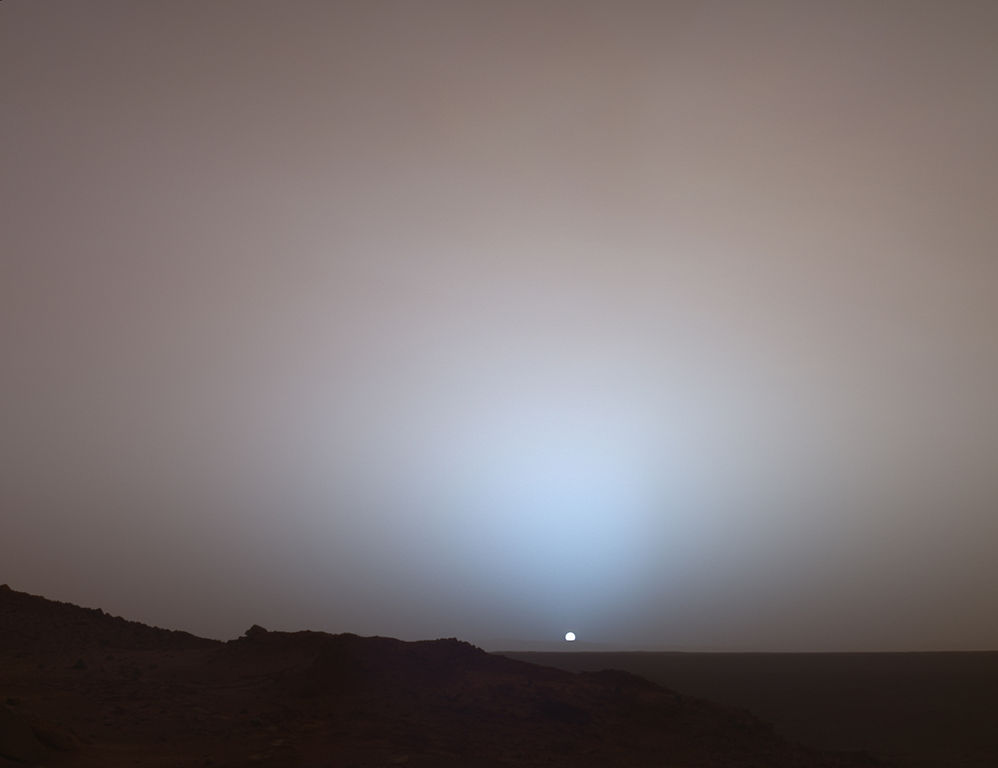
Spectacular Mars sunset
Propelled by an Atlas V rocket, the ambitious mission will last two years and focus on the Gale crater. Also known as the Mars Science Laboratory, this rover will carry more scientific equipment than has ever been sent to another planet.

Curiosity will attempt a first ever, multi-stage precision landing. It will use a combination of a supersonic parachute deployed at approximately 10 km (6.2 miles) to slow decent of the spacecraft, eight directional rocket thrusters which will allow controllers to adapt to the environment and steer the craft towards the landing area. Finally, a 'sky crane' will gently lower the rover to the planet surface.

Mars Gale Crater
Gale crater is believed to be about three and a half billion years old and 154 km (more than 95 miles) in diameter. This location was chosen for the rich combination of morphologic and mineralogical evidence of water in Mars' past. It contains minerals that are conducive to fossil preservation and the crater provides a surface that Curiosity can navigate safely. The choice was designed to "...identify a particular geologic environment, or set of environments, that would support microbial life."

This mission comes on the heels of an attempt by Russian scientists to land a probe on one of Mars' moons, Phobos, and return samples to Earth. The spacecraft is currently trapped in low Earth orbit and scientists are struggling to restart booster engines before it falls back to Earth containing tons of unspent rocket fuel.

Watch the launch live plus other special events, documentaries, news conferences and much more at NASA TV.

images: NASA / JPL-Caltech
rover: http://www.nasa.gov/mission_pages/msl/index.html
gale crater: http://en.wikipedia.org/wiki/File:Gale_crater.jpg
Martian sunset: http://upload.wikimedia.org/wikipedia/commons/thumb/6/69/MarsSunset.jpg/998px-MarsSunset.jpg


First published as Mars Science Lab 'Curiosity' Will Search for Signs of Life


Monday, November 14, 2011

Crippled Russian Spacecraft Carries Toxic Payload

Russian spacecraft Phobos-Grunt
Russian scientists are struggling to restart engines in the Phobos-Ground Probe  which failed to leave orbit following launch on November 8, 2011. The ship, containing tons of dangerous rocket fuel, could drop out of orbit and fall to earth as soon as a few days from now or could linger in decaying orbit until around Christmas next month.

Tons of unspent rocket fuel and an uncontrolled re-entry could create a very dangerous combination depending on where the craft comes down and the state of the fuel.

If the fuel does not freeze, but remains liquid, it should burn up harmlessly before it reaches the ground. But if the toxic mixture freezes, it could survive re-entry and strike the Earth intact. According to James Oberg, formally with NASA and now a space consultant,
“About seven tons (6.4 tonnes) of nitrogen tetroxide and hydrazine, which could freeze before ultimately entering, will make it the most toxic falling satellite ever”
Signs of trouble began when Russian scientists lost contact with the probe and requested amateur astronomers worldwide to report any sightings. The craft was spotted by South American astronomers trapped in a low orbit, trailed by its' failed booster engines.

Software engineers have attempted upgrades, bug fixes and reboots of the system, but according to this report, they have so far been unable to communicate with the craft and hope is fading that a solution will be found before the batteries fail.
Mars Moon Phobos
 Engineers are hoping that if the spacecraft falls back to Earth, it will land in the ocean. Compared to the six ton UARS Satellite, which dropped out of orbit in September, 2011, this failed spacecraft and booster engines weighs over fourteen tons, most of which is unspent fuel.

The ship was headed for Mars moon Phobos on an ambitious mission  to return to Earth next year with about seven ounces of soil samples from the Martian moon. Instead, this is the just latest and most dangerous, in a very long string of failed missions to Mars by the Russian Federal Space Agency.

Article first published as Crippled Russian Spacecraft Carries Toxic Payload on Technorati.

images:
phobos ground probe: http://commons.wikimedia.org/wiki/File:Cebit_2011-fobos-grunt_together_with_upper_stage.jpg
phobos: http://commons.wikimedia.org/wiki/File:Phobos_PIA10369.jpg 

Sunday, October 23, 2011

Heads Up! Another Satellite is Falling to Earth


Article first published as Heads Up! Another Satellite is Falling to Earth on Technorati.

Pieces of another crippled satellite, this one the German ROSAT, are expected to fall to Earth this weekend, with perhaps thirty fragments surviving re-entry, including a one and a half ton, heat-resistant mirror traveling at 280 mph (450 kph).


The orbit of ROSAT takes it over the highly populated area between 53 degrees north and 53 degrees south latitudes. You can follow the current orbit here and view re-entry statistical animations.

Odds of someone actually being struck by a piece of the defunct ROSAT satellite are about one in 2000. Those are higher than the one in 3200 chances of being hit by the UARS satellite last month.

The six ton UARS (Upper Atmosphere Research Satellite) fell out of orbit and plunged into the Pacific Ocean around midnight on Sept 23, 2011. It briefly captured the worlds attention and spawned sales of 'I Survived The UARS Satellite Crash' T-Shirts.

Earth's orbit is clogged with the debris of fifty years of space exploration. A cloud of space junk orbits our planet which consists of more than 370,000 items including chunks of old satellites and rocket booster engines. Occasionally, the orbits of some of these objects degrade to a point where they are captured by Earths' gravity and fall toward the ground. Most of these are small and burn up upon re-entry.

Scientists are concerned we may have reached a 'tipping point' where continuous collisions could make passing through Earth's orbit too dangerous, potentially ending space travel as we know it.
 
The problem reached a critical level when the Chinese tested an anti-satellite weapon in 2007 which may have added 150,000 new pieces to the debris field. This was followed by a collision of two orbiting satellites in 2009. These two events doubled the number of objects in the space junk cloud and may have brought us perilously close to being trapped on Earth.

This gauntlet of debris may pose too great a risk for astronauts to pass through, and recently forced six residents of the International Space Station to take shelter in two docked Russian Soyuz spaceships when a piece of space debris threatened to strike the station. 
 
United States Defense Advanced Research Projects Agency (DARPA) released a report in 2009 called 'Catchers Mitt' which looked closely at the problem.

Strategies to deal with this envelope of space trash have ranged from lasers, nets to giant space sweepers, but the problem continues to snowball and no action has been taken as yet.

images:
http://www.flickr.com/photos/gsfc/4384863741/sizes/m/in/photostream/ 

European Space Agency: http://www.esa.int/